
How to Accommodate Dietary Restrictions at Coffee Stations

Last Updated: October 30, 2026
Quick Summary
Plan dietary restrictions before the event by surveying guests early, offering at least two plant-based milks, and labeling every drink component clearly. Set up separate dairy and plant-based milk pitchers, use individual syrup bottles, and have staff check product labels rather than guess when a guest asks about allergens.
Send a short questionnaire with invitations or RSVP forms to learn guests' needs.
Offer at least two plant-based milks, such as oat or almond, so guests have a choice.
Label every drink component, including syrups, toppings and tea, not just the main coffee.
Keep dairy and plant-based milk pitchers separate, and purge the steam wand between milk types.
Staff should check the product label or ingredient card before answering any allergen question.
Table of Contents
Why Coffee Stations Need a Dietary Plan Before the Event
Dietary restrictions can make or break a coffee service at a wedding, corporate event, or festival. Guests who cannot drink regular milk or who avoid certain add-ins may end up with nothing they can enjoy. At Thunderbird Coffee, we plan around these needs before the first espresso is pulled.
A plan made early keeps the station simple. Waiting until the morning of the event leaves little room to source alternatives or set up separate areas.
Here is what a good plan covers:
Which guests have dietary needs
Which drinks and add-ins can be offered safely
How each item will be labeled and served
Who on the team handles questions during service
Step 1: Build an Event Dietary Restrictions Questionnaire
Start by asking guests about their needs. A short questionnaire sent with invitations or RSVP forms works well for most events.
Ask about these common restrictions:
Dairy allergies or lactose intolerance
Vegan or plant-based preferences
Gluten sensitivity
Caffeine avoidance
Sugar or sweetener limits
Keep the questions short and clear. Guests are more likely to answer a simple form than a long one. Store the responses so your team can check them before service.
Step 2: Choose Dairy-Free Coffee Station Options
Dairy-free options are the most requested change at coffee stations. Offer at least two plant-based milks, such as oat or almond, so guests have a choice.
Keep these tips in mind:
Label each milk carton clearly
Keep plant-based milks separate from dairy to avoid mix-ups
Offer a caffeine-free option alongside decaf coffee
Include an unsweetened choice for guests avoiding added sugar
A dairy-free station is easy to set up with the right supplies.
Step 3: Set Up Your Station Checklist and Quantities
A written checklist keeps your station stocked and organized. Use it on the day of the event and again during teardown.

Your checklist should include:
Espresso beans, decaf, and tea
Dairy and plant-based milks
Syrups, sweeteners, and creamers
Cups, lids, stirrers, and napkins
Labels for every item
Adjust cup and milk quantities to the length of the event, since a three-hour reception needs more than a one-hour break. Use a step-by-step guide to calculating coffee quantities to estimate serving sizes and brewing ratios for your guest count.
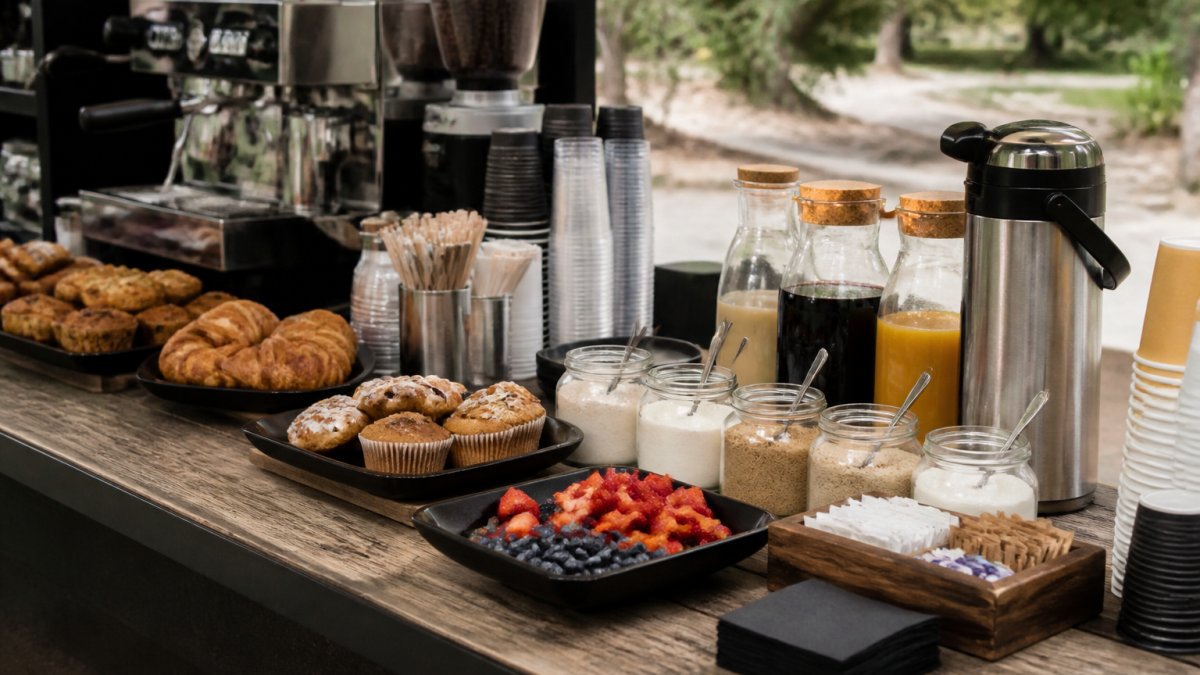
!A mobile espresso bar at an outdoor reception with clearly labeled dairy-free milk cartons, syrup bottles and neatly arranged cups
Step 4: Apply Allergen Labeling for Catered Events
Clear labels help guests choose safely, but at a coffee station the labeling job is bigger than most hosts expect. Guests can see the milk pitcher; they cannot see what is in the vanilla syrup, the caramel drizzle, the whipped topping, the chai concentrate, or the tea blend. Every one of those is a place an allergen can hide.
Label every drink component, not just the main coffee. A workable labeling system covers four groups:
Milks and creamers, the specific type (oat, almond, soy, whole dairy, half-and-half), plus whether it is sweetened or unsweetened
Syrups and sauces, flavor name, whether it contains dairy or soy, and whether it is sugar-free
Toppings and add-ins, whipped cream, cocoa powder, cinnamon, sprinkles, honey, and raw sugar, each with its own card
Tea and packaged products, the blend name and the manufacturer's allergen statement, since boxed chai, matcha, and flavored tea bags often carry "may contain" warnings
Each label should show four things: the item name, the common allergens present (dairy, soy, tree nuts, peanuts, wheat/gluten), whether the item is vegan, and whether it contains caffeine. For matching branded cups to your labeling plan, see custom branded coffee cups for catering events. A syrup that is dairy-free but made on shared equipment with tree nuts needs that noted, "dairy-free" and "allergen-free" are not the same claim.
Pro Tip Print one ingredient card per item and stand it directly in front of that item rather than posting a single master list at the end of the station. Guests read the card in front of the bottle they are about to pump, and they read it in the ten seconds they are standing there.
Keep the manufacturer's original packaging visible wherever possible, or photograph the ingredient panel and keep the photos in a binder at the station. When a guest asks "is the caramel dairy-free?" the answer should come from a label, not from memory. Guests with severe allergies should always be encouraged to ask a team member before choosing a drink, and staff should be able to hand them the packaging or the ingredient card rather than paraphrase it. Standardizing these protocols ensures that staff remain vigilant and consistent when accommodating food allergies across various high-traffic service environments.
Watch Out Do not label an item "allergen-free" based on its name. Caramel, mocha sauce, chai concentrate, and flavored syrups routinely contain dairy or soy, and "non-dairy" creamers can still contain milk-derived proteins. Read the panel on the specific product you are serving.
The article's labeling guidance can be scanned as a checklist of what each label should show and which products need extra attention.
Label element | What to include | Watch for |
Item name | Specific product or flavor name | Caramel and chai can hide dairy or soy |
Common allergens | Dairy, soy, tree nuts, peanuts, wheat/gluten | Check the actual product panel |
Vegan status | Whether the item is vegan | Non-dairy creamers may contain milk proteins |
Caffeine | Whether the item contains caffeine | Include decaf and tea blends |
Packaged products | Manufacturer allergen statement | "May contain" warnings on boxed chai and matcha |
Step 5: Prevent Cross-Contact at Catered Events
Cross-contact happens when an allergen touches a safe food or drink. At a coffee station the highest-risk points are concentrated in a few places: the steam wand, the milk pitchers, the syrup pumps, the spoon jar, and the counter where cups are set down. A few habits close most of the risk.
Milk handling. Use separate pitchers for dairy and plant-based milks, and keep them physically apart, dairy on one side of the station, plant-based on the other, never sharing a tray. Dedicate one pitcher per plant-based milk so oat and almond do not share a vessel. Wipe and purge the steam wand between every milk type, not just between drinks; a wand that steamed whole milk will carry dairy residue into the next oat latte. If the station runs a high volume, a second wand or a dedicated plant-based pitcher set is worth the setup time.
Syrups and pumps. Shared pumps are a quiet cross-contact route, especially for guests avoiding gluten or nuts in flavored syrups. Where the menu allows, use individual bottles with their own pumps rather than one pump moved between bottles. Keep a separate spoon for each add-in bowl, and never let a spoon travel from the whipped cream to the sugar.
Surfaces and hands. Change gloves between drink types when a guest has flagged an allergy, wipe the counter between rushes, and keep dairy and plant-based supplies on separate shelves in the storage crate so the setup itself does not mix them.
When the answer is uncertain. Staff should never guess. A clear protocol:
Stop and check the product label or the ingredient card before answering.
If the label is unclear or the packaging is gone, tell the guest the information is not confirmed, do not offer a best guess.
Escalate to the catering lead or the event contact, who can check the manufacturer's allergen statement.
Offer the guest a confirmed-safe alternative, such as a plain black coffee, a tea with a known blend, or an unsweetened plant-based milk with no syrup.
Key Takeaway The goal is not to promise a drink is allergen-free. The goal is to give every guest accurate information and a confirmed-safe option, and to make it easy for staff to say "I don't know, let me check" without pressure to improvise.
A short pre-event briefing on these four points, milk handling, pumps, surfaces, and the uncertainty protocol, takes about ten minutes and prevents most of the problems that come up during service.
Booking Your Dietary-Friendly Coffee Service with Thunderbird Coffee
Planning a dietary-friendly station takes time, and it is easier with a team that handles the details. Thunderbird Coffee brings more than 17 years of experience to weddings, corporate events, and festivals across Austin. Our mobile coffee catering service can set up a station that fits your guest list and menu needs.
Ready to get started? Use our mobile coffee catering inquiry to request a custom quote for your event. Tell us your guest count and dietary needs, and we will help you plan the rest.
Frequently Asked Questions
What are common dietary restrictions to plan for at a coffee station?
The restrictions that most often affect a coffee station are dairy-free needs, vegan preferences, gluten sensitivity, nut allergies, caffeine avoidance and low-sugar requests. Dairy-free and nut-related concerns matter most because milk alternatives, syrups and toppings can contain hidden allergens. Ask guests directly on your invitation or registration form rather than guessing. Then match the station's offerings to the answers you collect so each guest has at least one drink they can safely order.
How can a coffee station accommodate dairy-free guests?
Offer at least two dairy-free milk options, such as oat or almond milk, and keep them in separate, labeled containers. Use dedicated pumps or pour spouts so guests can see what is in each. Check that sweeteners, syrups and chocolate powders are also dairy-free, since many contain milk derivatives. A small sign listing each option and its ingredients helps guests choose quickly and reduces questions at the counter.
How do you prevent cross-contact at a catered coffee station?
Keep dairy-free and standard milks in separate containers and use separate pitchers or steam wands where possible. Provide individual spoons for each syrup and sweetener so they do not touch between flavors. Wipe the counter between service periods and keep add-ins covered. Train staff to change gloves and use clean utensils when preparing an allergy-specific drink, and make sure guests know the process so they feel confident ordering.
What should you include on a dietary restrictions form for an event?
Include a short list of common restrictions, a line for any severe food allergies and a free-text box for other needs. Ask specifically about dairy, nuts, gluten, caffeine and sugar, since these affect coffee drinks. Set a clear deadline so your caterer has time to plan. Keep responses confidential and share only the summarized needs with your coffee provider, not each guest's personal details.

Comments