
How to Plan Beverage Service for Multi-Day Corporate Retreats

Last Updated: November 4, 2026
Quick Summary
Beverage service planning for a multi-day corporate retreat starts with three numbers: headcount, program length, and the daily schedule. Budget in five line items, add a 10 percent contingency, and size supplies per service window with a daily restock cadence.
Count total attendees and add a 5-10% buffer for late additions.
Split the budget into base beverage cost, service and labor, equipment, consumables, and contingency.
Keep the contingency near 10 percent and track it as a separate line.
Size each service window to its own demand, with the morning rush and mid-morning break usually heaviest.
Split perishable restocks into two-day blocks to limit spoilage and storage risk.
Table of Contents
Start With Headcount, Schedule and Program Length
Successful beverage service planning for multi-day corporate retreats starts with three numbers: how many people attend, how long the program runs, and what the daily schedule looks like. Get these right first, and every other decision gets easier. Refining these logistical variables provides the essential foundation for comprehensive corporate retreat planning that ensures every session remains properly fueled.
Headcount drives volume. Count everyone who will be on site, including speakers, facilitators, and staff. Add a small buffer for late additions, since last-minute guests are common at offsites.
Program length changes how much you order. A two-day retreat and a five-day retreat do not need the same plan, even with the same group. Longer events mean more restocking, more service windows, and more chances for supplies to run low.
Then map the daily schedule. Note the morning arrival rush, mid-session breaks, meal times, and evening events. Each of these is a service window, and each one needs its own plan.
Count total attendees, plus a 5-10% buffer
Note the number of program days
Mark every break, meal, and evening event on the schedule
Set Your Beverage Service Budget
Beverage costs are easy to underestimate because they add up across many small orders, restocks, and service windows. A clear budget keeps spending under control before the event starts.
Build the budget as line items rather than one lump figure. Most planners find the total splits into five buckets:
Base beverage cost, espresso, drip coffee, tea, cold drinks, and dairy and non-dairy milk, priced per drink or per gallon
Service and labor, barista hours across every service window, including setup and teardown
Equipment and setup, mobile bar, grinders, brewers, signage, and any delivery or setup charge
Consumables, cups, lids, sleeves, stirrers, napkins, and labels
Contingency, a reserve of roughly 10 percent for late additions, weather-driven demand swings, and restocks
Start with a per-person, per-day beverage figure, multiply by headcount and program days, then add the other four buckets on top. Keep the contingency separate so it does not get absorbed into the base line.
Cost drivers shift the total more than headcount alone. Longer service windows raise labor hours. Specialty drinks raise base cost per cup. Multiple service points raise equipment and setup charges. Cold drinks in warm weather raise volume. Map which drivers apply to your retreat before you compare quotes, so you are comparing like for like.
Pricing depends on quantity, dates, delivery, and service window, so request a quote from Thunderbird Coffee for current figures that fit your event.
Watch out: Budgets often miss staffing hours and restock trips. Confirm whether your quote covers the full service window, from setup through cleanup, and whether a mid-event restock is included or billed separately.
The budget splits into five line items, and each cost driver shifts the total in a different way.
Budget bucket | What it covers | Note |
Base beverage cost | Espresso, drip coffee, tea, cold drinks, milk | Priced per drink or per gallon |
Service and labor | Barista hours across every service window | Includes setup and teardown |
Equipment and setup | Mobile bar, grinders, brewers, signage | Check for delivery or setup charges |
Consumables | Cups, lids, sleeves, stirrers, napkins, labels | Itemize per day |
Contingency | Late additions, demand swings, restocks | Roughly 10 percent, kept separate |
Plan Corporate Coffee Catering Logistics
Logistics decide whether a beverage service runs smoothly or turns into a bottleneck. Plan the setup, power, space, and timing before the first guest arrives. For office-style events, our mobile coffee planning guide for office parties covers setup, power needs, barista staffing, and menu options.

Build a timeline that covers setup, the first service window, restocking, and teardown each day. Share it with the venue and your catering team so everyone knows when to expect them.
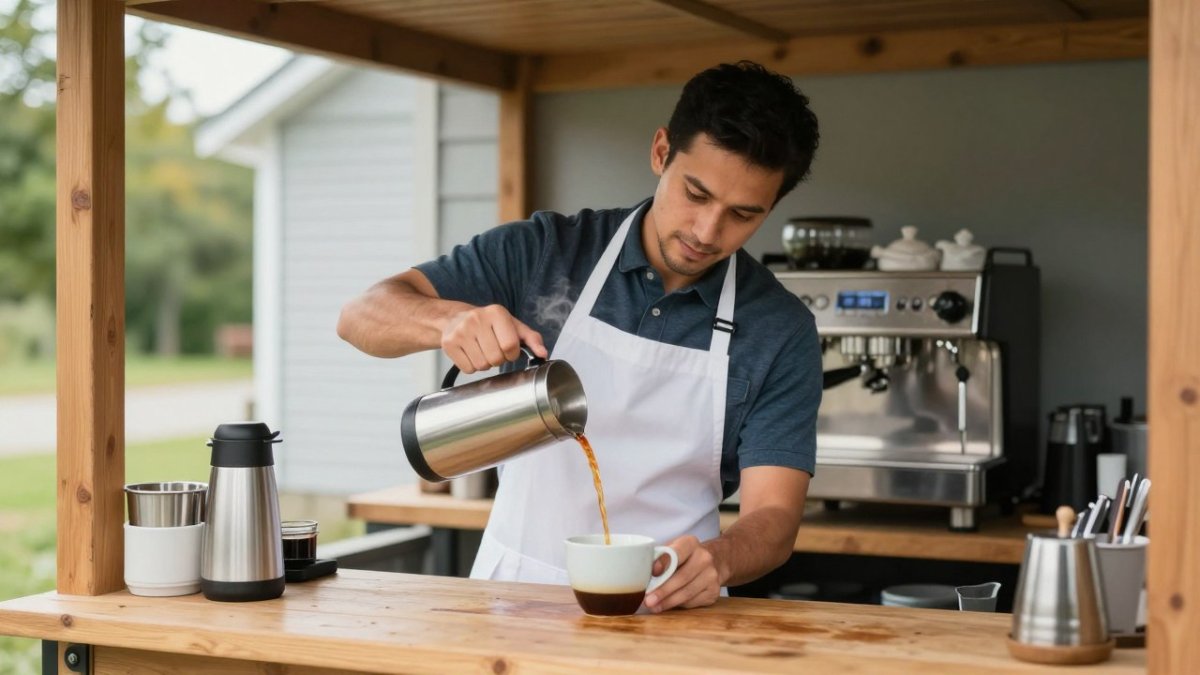
!A mobile espresso bar set up at an outdoor corporate gathering, with a barista preparing drinks for a line of smiling attendees
For a planner-level walkthrough of timelines, setup, and vendor coordination, see our complete corporate coffee catering planner.
Build a Beverage Menu That Covers Every Guest
A good menu serves both the coffee lover and the guest who wants something else. Keep the core menu simple, then add options that fit your group.
Start with classic espresso drinks and drip coffee. Add cold options for warm days, and include tea for guests who skip coffee. Keep the list short enough that the line moves quickly.
To size the menu, estimate how many drinks each guest will order per service window, then multiply by headcount. Round up for peak breaks, when most of the group lines up at once.
For guidance on sizing cups, pastries, and drinks for any guest count, read our guide on calculating coffee quantities for events.
Offer 2-3 hot coffee options
Add one cold drink and one tea option
Include water and at least one non-caffeinated choice
Dietary Requirements and Non-Alcoholic Options
Ask guests about dietary needs during registration, not on the day of the event. Common needs include dairy-free milk, sugar-free syrups, and decaf coffee.
Label every milk, syrup, and add-in clearly at the station. Keep allergen items in separate containers, and use fresh tongs or scoops for each item.
Non-alcoholic options matter at corporate events. Many attendees skip alcohol, and sparkling water, mocktails, and specialty teas give everyone something to hold during evening events.
For practical steps on collecting guest needs and labeling the station safely, see our guide to accommodating dietary restrictions at coffee stations.
Is Organic Coffee Worth It for Office Events?
Organic coffee costs more than conventional coffee, and whether it is worth the extra spend depends on your group and your goals. Planners often ask this question when they want a more sustainable option.
Organic beans are grown without synthetic pesticides, which appeals to guests who care about sourcing.
Best for: Companies that have made sustainability part of their culture. Skip if: Your budget is limited and your guests mostly order standard espresso drinks.
Manage Inventory and Service Across Multiple Days
Multi-day events need a supply plan that repeats every day without running short or over-ordering. Running out of milk on day three is a common and avoidable mistake in beverage service planning, and so is throwing away a case of perishables on the last morning. The fix is a quantity model plus a daily restock cadence.
Calculate quantities per service window, not per event. For each window, estimate drinks per guest, then convert to supplies: milk per drink, cups per drink, syrups per specialty order. Multiply by the number of windows per day, then by program days. Add a reserve of roughly 10 to 15 percent for peak breaks, when most of the group lines up at once.
A common pattern is that demand is not flat across the day. The morning arrival rush and the mid-morning break usually carry the heaviest coffee volume, while the afternoon break skews toward cold drinks and water. Size each window to its own pattern rather than averaging across the day.
Perishables need their own plan. Confirm cold storage space with the venue before the event, and set a daily restock window early enough that the morning service starts on time. Order perishables in two-day blocks where possible so a spoiled or delayed delivery does not take out the whole event.
Track usage at each break with a simple log: what was opened, what ran low, what was left over. Over three days, that log shows clear patterns, such as the afternoon break using twice as much cold brew as the morning, and it lets you adjust the next day's order instead of guessing.
Reduce waste with three habits. First, brew and batch in smaller amounts and top up through the window rather than brewing the full day's volume at once. Second, keep unopened perishables sealed and labeled with dates so they carry to the next day. Third, plan a final-day drawdown so the last service uses up open stock before anything new is opened.
Watch out: A single large delivery on day one feels efficient but raises spoilage and storage risk. Split restocks across the event and confirm the venue can hold the reserve.
Book Your Retreat Beverage Service With Thunderbird Coffee
Thunderbird Coffee brings over 17 years of coffee experience to events, with professional baristas who manage the service so your team can focus on the program.
Our mobile coffee catering team handles setup, service, and teardown. We use locally-roasted, hand-picked beans.
Ready to plan your retreat? Request a mobile coffee catering quote from Thunderbird Coffee and tell us your headcount, dates, and program length.
Frequently Asked Questions
How do you calculate beverage quantities for a multi-day corporate retreat?
Start with the confirmed headcount, then estimate how many drinks each attendee will likely order per session, such as morning, midday and afternoon breaks. Multiply by the number of days, and add a buffer for late registrations and guests who return for a second cup. Build the count around service windows rather than a single daily total, because demand peaks at specific times. Confirm final numbers with your caterer at least a week before arrival so supplies match the schedule you have set.
What should be included in a beverage service plan for a three-day event?
A solid plan covers service times for each day, the drink menu including coffee, tea and non-alcoholic options, the number of stations needed, staffing levels, setup and teardown windows, and a plan for restocking. It should also name a point of contact on site and list dietary and allergy requirements. Include a backup plan for equipment or supply problems. Writing these details down before the event keeps the service consistent from the first morning through the last afternoon.
Is organic coffee worth it for office events?
Organic coffee can be a good fit for office events where attendees value sourcing and sustainability, and it signals care for guests who ask about ingredients. The trade-off is cost, since organic beans usually price higher than conventional ones, so decide based on your audience and budget. Ask your provider where the beans are sourced and how they are roasted.
How can mobile espresso catering enhance a corporate retreat experience?
A mobile espresso bar brings drinks to the meeting space, so attendees do not lose time walking to a café between sessions. Freshly prepared espresso drinks give breaks a more relaxed feel and can keep energy up during long workshops. A professional barista also handles the service, which leaves your team free to run the program. Ask your provider how the setup fits your venue and how quickly the line moves during peak breaks.


Comments