
Coffee Catering for Corporate Events: 2026 Planner Guide

Table of Contents
Coffee Catering for Corporate Events: What Full-Service Looks Like
Coffee Cart Catering Options and Package Tiers
What Changes Between Tiers
Branding and Customization
The Corporate Event Beverage Planning Checklist
Is Organic Coffee Worth It for Office Events?
How to Plan Coffee Service for Large Events
The Throughput Math
Stagger Service Windows
Manage the Queue
Staffing and Backup
Types of Events This Fits
Technical Logistics Checklist for Mobile Espresso Bars
Sustainability and Dietary Inclusion at Corporate Functions
Conclusion
Frequently Asked Questions
Last Updated: September 18, 2026
Coffee Catering for Corporate Events: What Full-Service Looks Like
Coffee catering for corporate events is a mobile, on-site beverage service where professional baristas prepare espresso drinks and specialty coffee for attendees at a venue of your choosing. This guide from Thunderbird Coffee breaks down how full-service coffee catering works and how to get the logistics right the first time.
Most planners underestimate one thing: coffee service is the last vendor they book and the first one guests remember. A well-run espresso bar keeps people at your event longer; a poorly planned one creates a line that swallows the room. Below, we'll show you what full-service coffee catering includes, how to size it for your headcount, and which details decide whether the day runs smoothly.
Key Takeaway Full-service coffee catering means the vendor brings the equipment, the baristas, the menu, and the cleanup. Your job is to confirm power, space, and timing before the event, not on the morning of.
Coffee Cart Catering Options and Package Tiers
Coffee cart catering usually comes in three formats: a drip and batch setup for high-volume simplicity, a full mobile espresso bar with a barista crafting drinks to order, and a hybrid that pairs espresso with cold brew or iced options for warm-weather events. Each tier changes your throughput, staffing needs, and menu range.
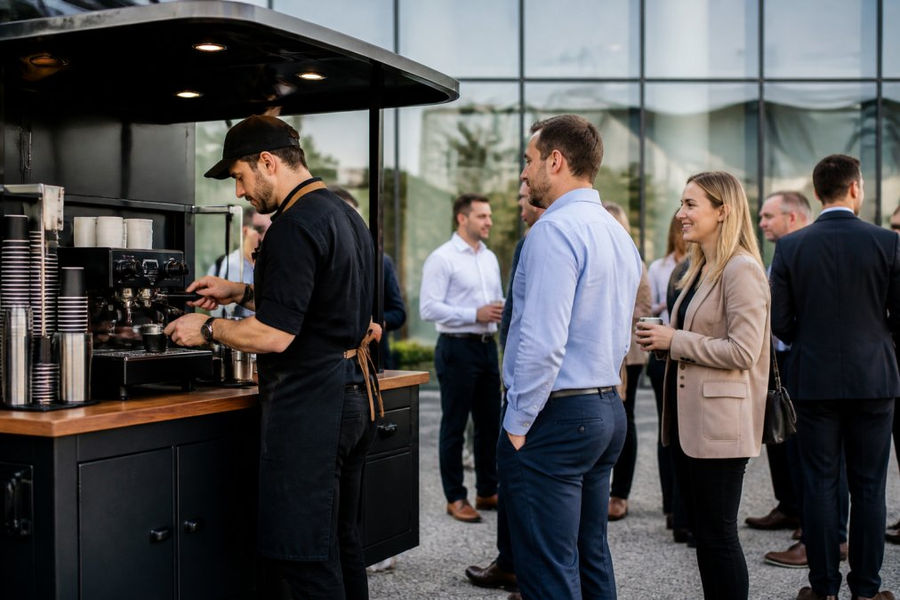
The right choice depends on your guest count and how much of the event revolves around the coffee itself.
Batch and drip service: Fastest throughput, simplest setup, best for large general sessions where speed matters more than variety. Typically includes pre-brewed urns, airpots, cups, lids, stirrers, creamers, and sweeteners, with the vendor refreshing urns on a set schedule.
Mobile espresso bar: Made-to-order drinks, latte art, and a menu your guests choose from. Slower per cup, but a far better attendee experience. Typically includes the espresso machine, grinder, milk frothing, a signature drink menu, and one or more baristas working the bar.
Hybrid espresso and cold brew: Adds iced and cold options so outdoor summer events and afternoon sessions stay comfortable. Typically includes everything in the espresso tier plus a cold brew dispenser or nitro tap and a dedicated cold station.
Key Takeaway Match the format to the moment. Batch service wins when everyone arrives at once; a made-to-order espresso bar wins when guests drift through over a longer window.
What Changes Between Tiers
Three variables move as you step up a tier: staffing, equipment footprint, and menu range. A batch setup may need one attendant and a small table. A full espresso bar needs a larger footprint, dedicated power, and at least one skilled barista per station. The hybrid adds a cold station and its own power and ice needs.
Branding and Customization
Most mobile coffee vendors offer some level of branding: a custom menu board, cups printed with your logo, a signature drink named for your company or event, and branded signage at the cart. Confirm what is included versus what carries an added charge, and how far in advance artwork is needed. Custom cups and printed signage require lead time, so raise branding at booking rather than the week of the event.
The Corporate Event Beverage Planning Checklist
A corporate event beverage planning checklist should cover guest count, service window, menu, power, space, staffing, and dietary needs before you sign a contract. Work through it in that order and most problems solve themselves.
Confirm final guest count and expected peak attendance
Set the service window (arrival, break, or all-day)
Choose your menu and any seasonal or signature drinks
Identify power access and outlet locations at the venue
Measure the footprint available for the cart
Confirm barista staffing for your headcount
Note dietary and decaf requests
Decide on custom cups or branded signage
Confirm setup and teardown times with the venue
Ask for the vendor's backup plan if equipment or staffing fails
Pro Tip Ask your venue for the exact outlet location and amperage before the vendor arrives. A cart that needs to run an extension cord across a walkway is a safety problem, and venues often restrict where cords can go.
Is Organic Coffee Worth It for Office Events?
Organic coffee is worth it for office events when your team or clients care about sourcing and sustainability, and when the vendor can confirm the beans are genuinely certified. For most corporate functions, the bigger quality lever is freshness and roast date, not the organic label alone. Organic certification speaks to how the coffee was grown; it says nothing about how recently it was roasted or how well it's brewed.
Where organic earns its place:
Your company has published sustainability commitments
Attendees include clients who ask about sourcing
The event is tied to a wellness or ESG initiative
How to Plan Coffee Service for Large Events
To plan coffee service for large events, calculate drinks per guest per hour, then match that number to barista count and equipment. A single barista can serve a limited number of made-to-order drinks per hour, so throughput, not menu ambition, drives your plan. Assume most guests take one drink during a defined break and a smaller share return for a second, then compare that total against the vendor's stated capacity.
Event Size | Recommended Format | Baristas Needed | Key Consideration |
Under 50 guests | Mobile espresso bar | 1-2 | Menu variety matters most |
50-150 guests | Espresso bar plus batch | 2-3 | Balance speed with quality |
150-300 guests | Hybrid espresso and batch | 3-4 | Stagger service windows |
300+ guests | Batch-led with espresso station | 4+ | Prioritize throughput |
The Throughput Math
Work the numbers before you book. If your event has a 20-minute break and 200 guests who mostly want coffee, a made-to-order espresso bar cannot keep up with one or two baristas. The fix is shifting that window to batch service, where drinks are poured rather than crafted, and saving the espresso bar for the slower stretches before and after.
Stagger Service Windows
Large events rarely have one coffee moment. They have several: arrival, mid-morning break, post-lunch, and afternoon. Treat each as its own service window with its own demand estimate. Staggering lets a smaller crew handle a larger crowd comfortably.
Manage the Queue
A coffee line that snakes across a room becomes the event's main attraction, and not in a good way. Position the cart so the line forms along a wall or open area rather than blocking a doorway, a fire exit, or the path to the food. If the venue has a natural flow, place the cart where guests pass it on the way in or out.
Staffing and Backup
Ask how the vendor handles a barista calling out sick or an espresso machine failing mid-event. A vendor with a stated contingency plan, a backup barista, a spare grinder, or a batch fallback, is carrying the risk for you. A vendor without one is transferring it to you.
Watch Out Booking a made-to-order bar for a short, high-traffic window is the most common planning error. If 200 people all want coffee in 20 minutes, switch to batch service for that window and save the espresso bar for the quieter hours.
Types of Events This Fits
The same planning logic applies across event types: conferences and trade shows, where dwell time and booth traffic matter; all-hands meetings and town halls, where a break needs to move quickly; client appreciation events, where the experience is the point; and recruiting or onboarding days, where a good cup leaves an impression. Each has a different peak pattern, so confirm service windows with the event owner before you size the crew.
Technical Logistics Checklist for Mobile Espresso Bars
Mobile espresso bars need three things confirmed before the event: power, space, and access. Get those wrong and even a great vendor can't deliver the service you paid for.
Sustainability and Dietary Inclusion at Corporate Functions
Sustainability and dietary inclusion come down to two questions: what happens to the waste, and can everyone at your event actually drink what's served. Both are easy to handle when you raise them at booking.
Pro Tip Ask the vendor to label the milk alternatives at the cart. Guests with dairy restrictions will skip the coffee entirely rather than ask, and a simple label removes that hesitation.
Conclusion
The hardest part of coffee catering for corporate events isn't the coffee. It's the planning that happens weeks earlier: confirming power, sizing staffing to your headcount, and settling the menu before the venue locks you in.
Frequently Asked Questions
How much should you charge a coffee cart for 80 guests in a corporate office?
Pricing depends on drink volume, service duration, staffing, and any custom branding, so there is no single flat rate. For 80 guests, most planners budget for two to three drinks per person across a two-hour window, which typically requires two baristas to keep lines moving. Request a custom quote with your guest count, date, and venue details so the provider can size the package accurately.
What should you look for when hiring a professional coffee catering service?
Check four things: staffing ratios (roughly one barista per 50 to 75 guests during peak hours), power and water self-sufficiency, a written setup and teardown timeline, and a backup plan if equipment or staff issues arise. Ask whether the menu includes dairy alternatives and decaf at no extra step, and confirm the provider carries liability insurance, which most venues require before allowing outside vendors on site.
How much space is required for a mobile espresso bar at an event?
Most mobile espresso bar setups need a footprint of roughly 8 to 10 feet wide and 6 feet deep, plus clearance for a guest queue that does not block fire exits or main walkways. Indoor setups need a standard grounded outlet within about 25 feet, while outdoor setups often run on generator power. Confirm your venue's load-in path, elevator dimensions, and any certificate-of-insurance requirements before the event date.
What types of drinks should a corporate coffee catering menu include?
A balanced menu covers espresso, Americano, cappuccino, and latte as core options, plus a cold brew or iced latte for warmer months and afternoon slots. Add one or two signature drinks tied to your brand or event theme, and always include decaf, oat milk, almond milk, and whole milk. For large groups, a batch-brewed drip or pour-over station alongside the espresso bar reduces wait times during peak arrival windows.
Book Today


Comments