
Best Coffee Catering for 2026: Complete Guide

Table of Contents
What Makes the Best Coffee Catering in 2026
Mobile Espresso Catering Trends 2026
How to Book a Coffee Cart for Weddings
Corporate Event Coffee Service Best Practices
Specialty Coffee Catering Menu Ideas
Key Factors: Service Capacity, Equipment & Logistics
Sustainability and Post-Event Considerations
Frequently Asked Questions
Last Updated: September 27, 2026
What Makes the Best Coffee Catering in 2026
The best coffee catering service combines three essential elements: exceptional bean quality, professional barista expertise, and seamless logistics.
What separates top-tier coffee catering from mediocre options? Consistency under pressure. A wedding with 150 guests or a corporate retreat with 200 attendees demands baristas who can maintain quality while managing high volume, understanding venue constraints, power requirements, space limitations, and weather considerations.
At Thunderbird Coffee, we've spent 17 years perfecting mobile espresso service. Hand-crafted drinks made from locally-roasted, hand-picked beans elevate your event. Exceptional coffee catering requires intentionality at every stage: bean selection, equipment maintenance, barista training, and cleanup.
Mobile Espresso Catering Trends 2026
Mobile espresso catering offers various service models, including premium espresso bars with professional equipment and trained baristas, cold brew tap systems, and hybrid models combining espresso with specialty options.
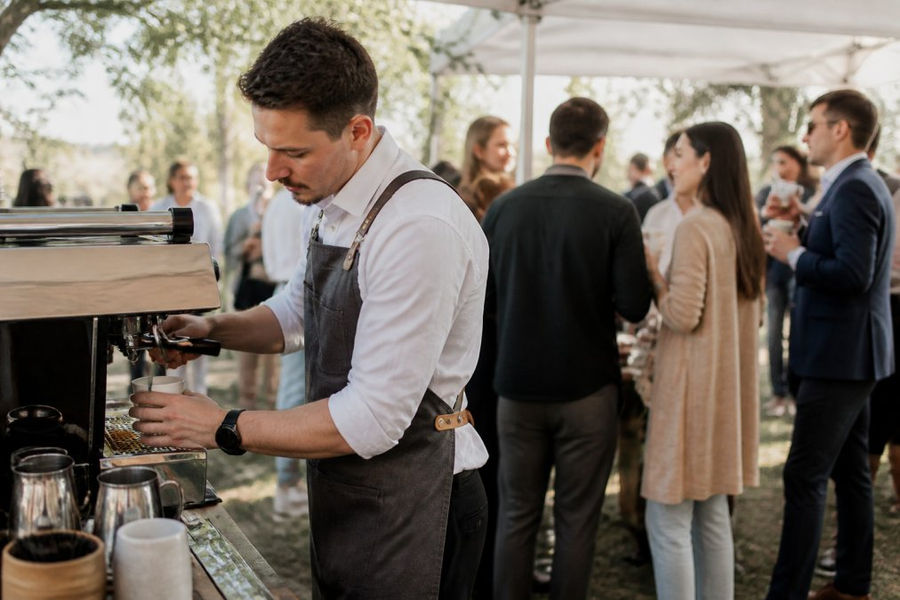
Personalization through branding is now standard. Custom cups and menu cards that match your event aesthetic contribute to the overall guest experience and brand messaging.
Sustainability is now baseline. Waste-conscious sourcing is a standard expectation; guests notice whether your event operates responsibly.
Pre-event consultations are now standard. Quality services ask about guest count, dietary restrictions, venue power availability, outdoor space, and timeline, details that shape equipment choice and staffing levels.
How to Book a Coffee Cart for Weddings
Capacity: A standard mobile espresso setup handles 80-120 guests over 2-3 hours. Beyond 150 guests, you need a larger setup, multiple baristas, or a hybrid model. Ask: "How many drinks per hour can your setup handle?" Vague answers signal inexperience.
Timing: Peak coffee service occurs during the first 90 minutes after the ceremony. Plan the service window explicitly rather than assuming it runs the entire reception.
Customization: Quality services ask about venue aesthetic, dietary preferences (oat milk, sugar-free syrups, decaf), and signature drinks tied to your theme.
Confirm setup and teardown timeline: professional services arrive 30-45 minutes early and complete cleanup within 30 minutes after service ends.
Corporate Event Coffee Service Best Practices
For smaller corporate gatherings, a single-barista setup with espresso works well. The barista can engage with guests and create a personable experience aligned with your company culture.
For larger corporate events (100+ people), use multiple baristas or a hybrid model. Corporate guests queue for quality coffee, so plan for higher throughput than social events.
Custom cups with your company logo, branded napkins, and menu cards create cohesion and extend brand visibility beyond the event.
Confirm power availability, parking access, and setup space in advance. Outdoor or remote venues require additional planning for power needs and weather contingencies.
Specialty Coffee Catering Menu Ideas
Standard menus (cappuccino, latte, espresso, Americano) are baseline. Exceptional catering requires intentional menu design.
Single-origin espresso drinks create conversation. Thunderbird Coffee sources locally-roasted, hand-picked beans to enable customization.
Cold brew tap systems are essential for outdoor and summer events.
Matcha lattes, specialty hot chocolate, and chai options demonstrate that non-coffee drinkers are valued.
Signature drinks tied to your event (e.g., "Bride's Brew" or "Corporate Celebration Latte") create memorable moments and Instagram appeal.
Dietary accommodations should be built into the menu: oat milk, almond milk, and sugar-free syrups are baseline professionalism.
Key Factors: Service Capacity, Equipment & Logistics
Three variables determine whether your coffee catering succeeds or creates bottlenecks: guest count, equipment specifications, and venue logistics. Unlike generic catering guides, this section provides the technical checklist event planners and venue coordinators actually need to vet a provider and confirm your space is suitable.
Service Capacity & Throughput
Service capacity depends on the espresso machine's group head count and the barista's speed. A single-group machine handles roughly 20-25 drinks per hour at a relaxed pace, or 40-50 per hour during a rush if the barista is highly skilled. A dual-group machine doubles that throughput. For 200 guests expecting coffee service over 2 hours, you need either multiple machines or a hybrid model that includes pre-made cold brew.
Ask your service provider: "How many drinks per hour can your setup handle at peak demand?" and "What's your standard barista-to-guest ratio for events over 150 people?" Vague answers signal inexperience.
Power Requirements & Electrical Infrastructure
An espresso machine draws 15-20 amps at full capacity; a grinder adds another 5-10 amps. Standard event venues may have limited electrical infrastructure, especially outdoors or in older buildings. Before booking, confirm your venue has:
A dedicated 20-amp circuit within 50 feet of your setup location
Weatherproof outlets if service is outdoors
Backup power plan if the venue's electrical system is unreliable
If your venue lacks adequate power, ask whether the service provider can bring a generator. Portable generators add operational cost, produce noise, and require fuel management. Confirm generator logistics and placement in advance; many venues restrict generator placement near guest areas.
Water Supply & Drainage
Espresso machines require a consistent water source. A typical mobile setup consumes 20-30 gallons of water over a 3-hour service window (for espresso, steam, and equipment rinsing). Confirm your venue can provide:
A potable water connection within 25 feet of the setup
Drainage for wastewater (or permission to collect and remove it)
Water pressure between 40-90 PSI (most venues meet this standard)
If your venue lacks a water connection, the service provider can bring pre-filtered water in tanks, but this adds setup complexity and cost. Outdoor or remote venues often require this workaround.
Space & Ground-Level Requirements
A mobile espresso cart requires roughly 8×4 feet of level ground, plus 4-6 feet of approach space for guests to queue. Confirm:
The setup surface is level (uneven ground causes espresso machine calibration issues)
The ground is stable (grass or gravel can shift under equipment weight)
Overhead clearance is at least 8 feet (for steam and barista movement)
The location is sheltered from wind and rain (wind disrupts steam, rain damages electrical connections)
Outdoor venues should have a tent or covered area. If weather contingency is unclear, ask: "What's your protocol if rain begins during service?" Professional services have weatherproofing plans; unprepared providers will scramble.
Setup & Teardown Timeline
A professional setup typically requires 30-45 minutes before service begins. This includes equipment positioning, power connections, water supply setup, equipment testing, and final quality checks. Don't schedule service to begin immediately after arrival; allow a buffer for final preparations and troubleshooting.
Teardown and cleanup should be completed within 30-45 minutes after service ends. This includes removing all spent coffee grounds, sanitizing equipment, disposing of waste, and restoring the venue to its original condition. Confirm cleanup expectations in writing; professional services should leave no trace of the operation.
Waste Management & Post-Event Logistics
Waste management is a logistics detail that separates professional operations from amateur ones. Quality services bring their own waste containers and remove all spent grounds, cups, and packaging. Confirm your provider's waste protocol:
Are spent coffee grounds removed or left for you to dispose of?
Are compostable cups actually composted, or landfilled?
Does the service provider handle all cleanup, or do you share responsibility?
Will they provide a brief post-event summary (drinks served, any issues, feedback)?
You should not inherit piles of coffee debris after the event. This detail prevents venue coordinator frustration and demonstrates respect for the space.
Sustainability and Post-Event Considerations
Environmental responsibility has become a core expectation in event planning, particularly for corporate events tied to ESG (Environmental, Social, and Governance) goals. The best coffee catering services operate with sustainability built into their model, not bolted on as an afterthought. This section provides a framework for evaluating providers against your sustainability commitments and understanding the real environmental impact of your catering choice.
Compostable vs. Truly Composted: The Critical Distinction
Compostable cups and lids are now standard across quality services, but the real question is whether they're actually composted or landfilled. If cups go to landfill, they're not truly compostable; they're just more expensive trash.
Ask your service provider directly: "Do you partner with a commercial composting facility?
Water Usage & Equipment Efficiency
Bean Sourcing & Direct-Trade Relationships
Waste Audit & Post-Event Accountability
Professional services should provide a brief post-event summary documenting:
Total drinks served (espresso-based, cold brew, specialty beverages)
Waste generated (cups, lids, sleeves, spent grounds by weight if possible)
Composting or recycling actions taken
Any operational issues or guest feedback
Cost-Per-Head Transparency & Sustainability Trade-offs
When requesting a quote, ask for a itemized breakdown:
Base service cost (barista, equipment, standard cups)
Sustainability upgrades (compostable cups, reusable drinkware, premium sourcing)
Cost per guest for your expected attendance
Post-Event Cleanup & Venue Restoration
Cleanup work extends beyond removing cups. Professional services should:
Remove all spent coffee grounds
Wipe down and sanitize all equipment
Dispose of waste properly (composting, recycling, or landfill as appropriate)
Leave the venue in the same condition they found it
Provide the post-event summary noted above
Frequently Asked Questions
How far in advance should I book mobile coffee catering for my event?
Most professional coffee catering services recommend booking 4-8 weeks ahead for weddings and corporate events, especially during peak seasons. For smaller gatherings or festivals, 2-4 weeks is often sufficient. Early booking ensures your preferred dates are available and gives the barista team time to discuss your menu preferences, guest count, and venue logistics. Last-minute bookings may be possible but typically limit customization options.
What equipment and power requirements do I need to provide for a mobile espresso bar?
Most mobile coffee catering setups require a 15-amp electrical outlet (standard household outlet) or access to a generator. The barista typically handles all equipment transport and setup, including the espresso machine, grinder, water supply, and serving station. Confirm with your vendor whether they provide their own power solution or need access to your venue's electricity. For outdoor events, ensure adequate shelter from weather and a level surface for safe equipment operation.
Can coffee catering accommodate dietary restrictions and specialty drink requests?
Yes. Most professional coffee catering services offer customizable menus featuring options like oat milk, almond milk, and dairy-free alternatives. Many also provide specialty drinks such as matcha lattes, cold brew, and single-origin pour-overs. Discuss your guest's dietary needs and preferred beverages when booking. Experienced baristas can prepare handcrafted drinks tailored to your event theme and guest preferences, ensuring every attendee finds something they enjoy.
What's included in a typical full-service coffee catering package?
A full-service mobile espresso catering package typically includes professional barista staffing, all espresso equipment and supplies, fresh-roasted beans, specialty syrups and milk options, cups and napkins, and complete setup and teardown. Many services offer customizable menu options, branded cups with your logo, and the ability to scale service based on guest count. Confirm what's included, some vendors charge separately for add-ons like matcha service, cold brew taps, or extended service hours.
Book Today


Comments